
With the amount of information and misinformation floating around, it's hard to know if the products you're purchasing and giving your dog are actually beneficial to their health and wellbeing.
Let's cut through the common beliefs and find out what the evidence tells us.
Common beliefs
Click on the options below to read more.
All pet food manufactured in Australia is the best option.
🔴 FALSE
Not all dog food is created equally, even when it's made in Australia. While I've done my best to research the available information, there are limitations around the level of information manufacturers are required to disclose and the evidence available to verify quality.
So, how do I choose the foods I offer?
I've created the framework below to help me identify products with stronger evidence of nutritional adequacy, manufacturing standards, independent oversight and transparency.
A note on AS5812:
A manufacturer doesn't have to participate in independent auditing against AS5812, and choosing not to doesn't mean their food is poor quality. Smaller businesses in particular may not have the resources to undertake voluntary certification. However, if I can't independently verify the standards and quality of a product, I've chosen not to stock it.
🔎 Want to dig a little deeper?
- Pet Food Standards - Pet Food Industry Association of Australia (PFIAA)
PFIAA - Pet Food Standards
In-text: (PFIAA, n.d.) - BICON - Australian Biosecurity Import Conditions System
Australian Government - BICON
In-text: (Australian Government Department of Agriculture, Fisheries and Forestry, n.d.) - Lack of regulation in the Australian pet food industry - ABC News (2024)
ABC News - Pet food regulation
In-text: (ABC News, 2024) - Building trust through choice: The power of self-regulation in the Australian pet food industry - PFIAA
PFIAA - Self-regulation in the pet food industry
In-text: (PFIAA, n.d.) - Reading Pet Food Labels - AAFCO
AAFCO - Understanding Pet Food Labels
In-text: (AAFCO, n.d.) - Pet Food Regulation - CHOICE
CHOICE - Pet food regulation
In-text: (CHOICE, n.d.)
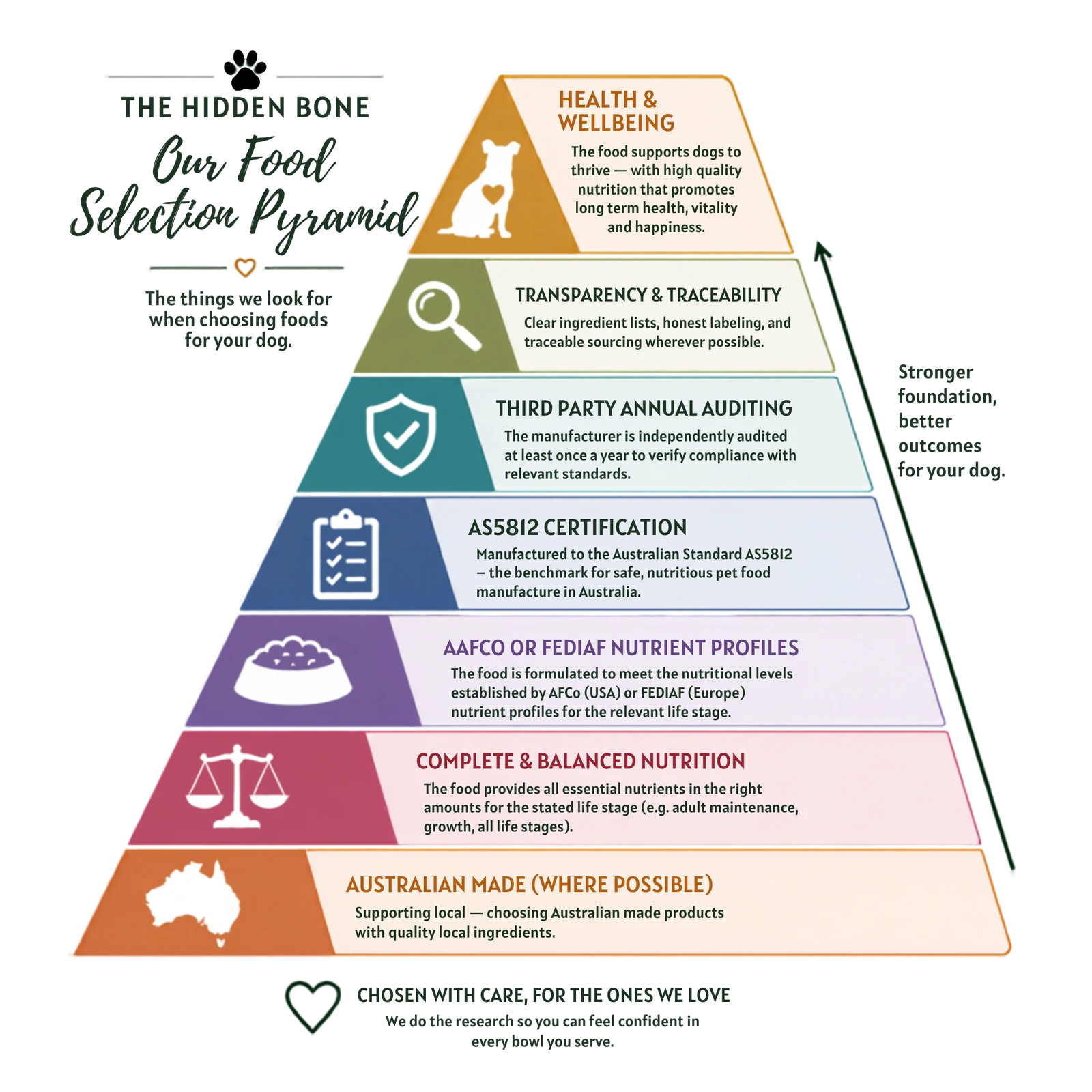
Read the diagram as text
From the base to the top:
- Australian made (where possible)
Supporting local — choosing Australian made products with quality local ingredients.
- Complete & balanced nutrition
The food provides all essential nutrients in the right amounts for the stated life stage (e.g. adult maintenance, growth, all life stages).
- AAFCO or FEDIAF nutrient profiles
The food is formulated to meet the nutritional levels established by AFCo (USA) or FEDIAF (Europe) nutrient profiles for the relevant life stage.
- AS5812 certification
Manufactured to the Australian Standard AS5812 — the benchmark for safe, nutritious pet food manufacture in Australia.
- Third party annual auditing
The manufacturer is independently audited at least once a year to verify compliance with relevant standards.
- Transparency & traceability
Clear ingredient lists, honest labeling, and traceable sourcing wherever possible.
- Health & wellbeing
The food supports dogs to thrive — with high quality nutrition that promotes long term health, vitality and happiness.
Stronger foundation, better outcomes for your dog. Chosen with care, for the ones we love.
We do the research so you can feel confident in every bowl you serve.
My dog has itchy skin, so it must be an environmental allergy.
🔴 FALSE
Itchy skin can certainly be caused by environmental allergies such as grasses or pollen, but there are many other possibilities - including parasites, bacterial or yeast infections, skin conditions and food allergies. Because these can look very similar, it's worth having your dog checked by your vet.
Skin problems can be frustrating, time-consuming and expensive to investigate, so here are a few things worth knowing about:
- Rule out infection
Skin that is inflamed, damaged or itchy can develop secondary bacterial or yeast infections. Your vet can assess the skin and, where appropriate, perform cytology to help identify infection. - Consider environmental triggers
If you suspect grass or environmental allergens, reducing exposure may help. I use a barrier product on Galaxy's belly before she plays outside, then wipe her belly with a damp washer when we come home.
And don't forget what's under their feet. Contact allergies can be triggered by plants such as Wandering Trad and Moses in the Cradle, but substances around the home - including cement, floor polishes and carpet deodorisers - can also affect some pets. (Dermcare-Vet, n.d.) - Don't overlook yeast
Yeast can contribute to itchy, irritated skin. Chlorhexidine and Miconazole are commonly used together in veterinary dermatology for Malassezia-associated skin disease, but your vet can advise whether this is appropriate for your dog. - Keep parasites covered
Fleas and mites can cause significant itching, so keeping your dog's flea and parasite prevention up to date is an important part of investigating itchy skin. - Food allergies are possible too
Food allergies can produce symptoms that look very similar to other forms of allergic skin disease. Common food allergens identified in dogs with adverse food reactions include beef, dairy, chicken and wheat, among others. (Mueller et al., 2016)
An elimination diet may be recommended by your vet when investigating a food allergy. In addition, don't assume a food is chicken-free simply because "chicken" isn't written on the front of the bag. Ingredients such as poultry meal / fat / digest or oil may require further clarification from the manufacturer.
If an extensively hydrolysed diet is recommended, products such as Royal Canin Anallergenic use extensively hydrolysed feather-derived protein. Hydrolysis breaks proteins into very small fragments, reducing the likelihood that they will be recognised as allergens.
A little reminder...
Your vet can perform skin examinations and cytology tests to help work out what's actually going on.
But if you're anything like me, you'll probably Google every possible cause before the appointment anyway. 😂 I find it helpful to understand the possibilities and arrive prepared with questions - while remembering that Google isn't the vet.
This information has been compiled from the resources listed below, along with my own experience managing Galaxy's allergies and conversations with my veterinarian and veterinary nurses. Because she's still young, my vet has also suggested that she may grow out of some of these issues. Fingers crossed!
- Dermcare-Vet - Allergy - Useful Australian veterinary information covering environmental, food and other allergies.
Dermcare-Vet - Allergy - Dermcare-Vet - Contact Allergy - Information about contact-related allergic skin disease.
Dermcare-Vet - Contact Allergy - Dermcare-Vet - Food Allergy - Information about canine food allergy and its presentation.
Dermcare-Vet - Food Allergy - Zoetis Australia - Canine Skin Infections - Information about infectious skin disease in dogs.
Zoetis Australia - Canine Skin Infections - Bond et al. (2020) - Malassezia dermatitis consensus guidelines - peer-reviewed veterinary dermatology guidelines covering diagnosis and treatment of Malassezia dermatitis.
Full article - Veterinary Dermatology - Mueller, Olivry & Prélaud (2016) - Common food allergen sources in dogs and cats - a peer-reviewed review of common food allergen sources.
Full article - BMC Veterinary Research - Royal Canin Australia - Anallergenic - Product information explaining the hydrolysed feather-derived protein formulation.
Royal Canin Australia - Anallergenic
Brushing my dog's teeth is the best form of dental care.
🟢 TRUE
Allan et al. (2019) found that daily tooth brushing was more than three times more effective at controlling plaque accumulation than a daily dental chew or prescription dental diet.
Allan, R. M., Adams, V. J., & Johnston, N. W. (2019). Prospective randomised blinded clinical trial assessing effectiveness of three dental plaque control methods in dogs. Journal of Small Animal Practice, 60(4), 212-217.
https://doi.org/10.1111/jsap.12964
Want to dig a little deeper?
These are some of the resources I used while researching and developing The Hidden Bone. If you fancy doing some digging of your own, you're welcome to explore them too.
- Pets in Australia - National Survey of Pets and People 2025
Animal Medicines Australia - FEDIAF Nutritional Guidelines - Complete and Complementary Pet Food for Cats and Dogs (2025) - The full nutritional guidelines, including recommended nutrient levels for complete dog food across life stages.
Read the FEDIAF Guidelines - Pet Owner Survey Report 2026 - Johnson's Veterinary Products
Read the 2026 survey report - Are we spending too much on our pets' healthcare? - ABC Radio National
Listen to the ABC discussion - Veterinary Controversies and Ethical Dilemmas: Provocative Reflections on Clinical Practice - Stephens, Clutton, Taylor & Murphy (Eds.), 2026
Routledge - Book information - Suicide in Australian Veterinarians - Jones-Fairnie et al. (2008)
PubMed - article information - A taxonomy of occupational and organisational stressors and protectors of mental health reported by veterinary professionals in Australasia - Connolly et al. (2022)
Full article - PMC